
You’ve done everything they told you to. And you wonder why your brain fog won’t go away.
You cut gluten. Then dairy. Then sugar. You take high-quality B vitamins every morning, magnesium glycinate before bed, omega-3s with breakfast. You bought blackout curtains, stopped looking at screens two hours before sleep, and track your sleep with an app that confirms you’re getting 7-8 hours.
You’ve seen functional medicine doctors who ran comprehensive panels (thyroid TSH, T3, T4, reverse T3, complete metabolic panel, inflammatory markers, gut health tests, hormone panels).
And your labs? Normal. Or close enough.
The doctors nod approvingly. “Everything looks good,” they say. “Maybe you just need to manage your stress better. Have you tried meditation?”
Yet the brain fog persists.
That heavy, underwater feeling that makes every thought require effort. Walking into meetings and forgetting what you were about to say. Reading the same paragraph three times because nothing’s sticking. Making decisions that used to be automatic (what to have for lunch, which email to answer first) now requiring mental energy you simply don’t have.
You’re operating at 70% when you used to be 100%.
And everyone keeps telling you it’s stress. Or aging. Or that you just need to relax more, take a vacation, try therapy.
But here’s what they’re missing: Your brain fog isn’t a symptom problem. It’s a cellular metabolic problem. And until you address that, the fog won’t lift, no matter how many supplements you take or how much you meditate.
What Most Doctors Miss: Treating Symptoms in Isolation
When you tell your doctor about brain fog, here’s what typically happens:
They check your thyroid. If your TSH is between 0.5 and 4.5 (the standard reference range), they move on. Maybe they’ll check T3 and T4 if you push, but if those are “in range,” that’s the end of the thyroid conversation.
They might check B12, vitamin D, iron. If you’re deficient, they prescribe a supplement and send you on your way. If you’re not deficient, well, then that’s not the problem.
If everything looks “normal,” you’ll hear one of these:
- “It’s probably stress”
- “Have you considered you might be depressed?”
- “This is just part of aging”
- “Maybe you need better time management”
- “Try exercising more (or maybe you’re exercising too much)”
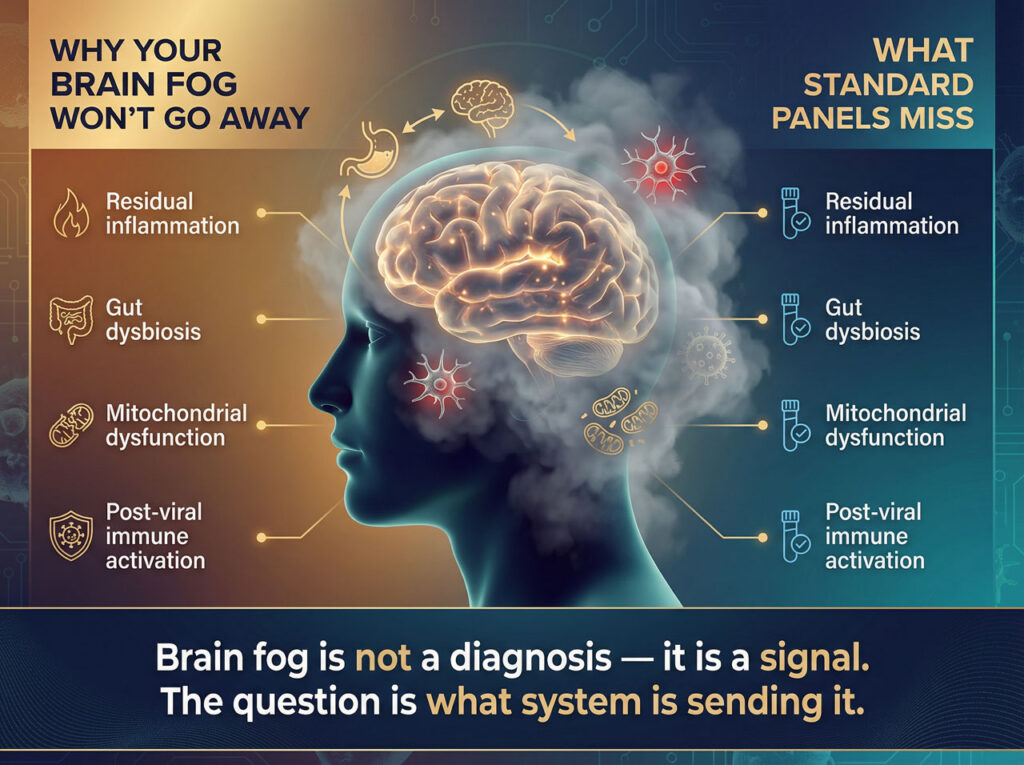
The problem? They’re looking at individual markers in isolation. They’re missing the pattern.
Your brain fog isn’t caused by a B12 deficiency or slightly suboptimal thyroid function. Those might be contributing factors, but they’re not the root cause.
The root cause is cellular metabolic dysfunction.
And most doctors don’t know how to look for it because standard labs don’t measure it.
The Cell Danger Response: What’s Actually Happening in Your Cells
In 2013, Dr. Robert Naviaux at UC San Diego published groundbreaking research identifying something called the Cell Danger Response (CDR).
If you haven’t heard of it, you’re not alone. Most practicing physicians haven’t either. But understanding this framework explains why your brain fog persists despite doing everything “right.”
Here’s the simplified version:
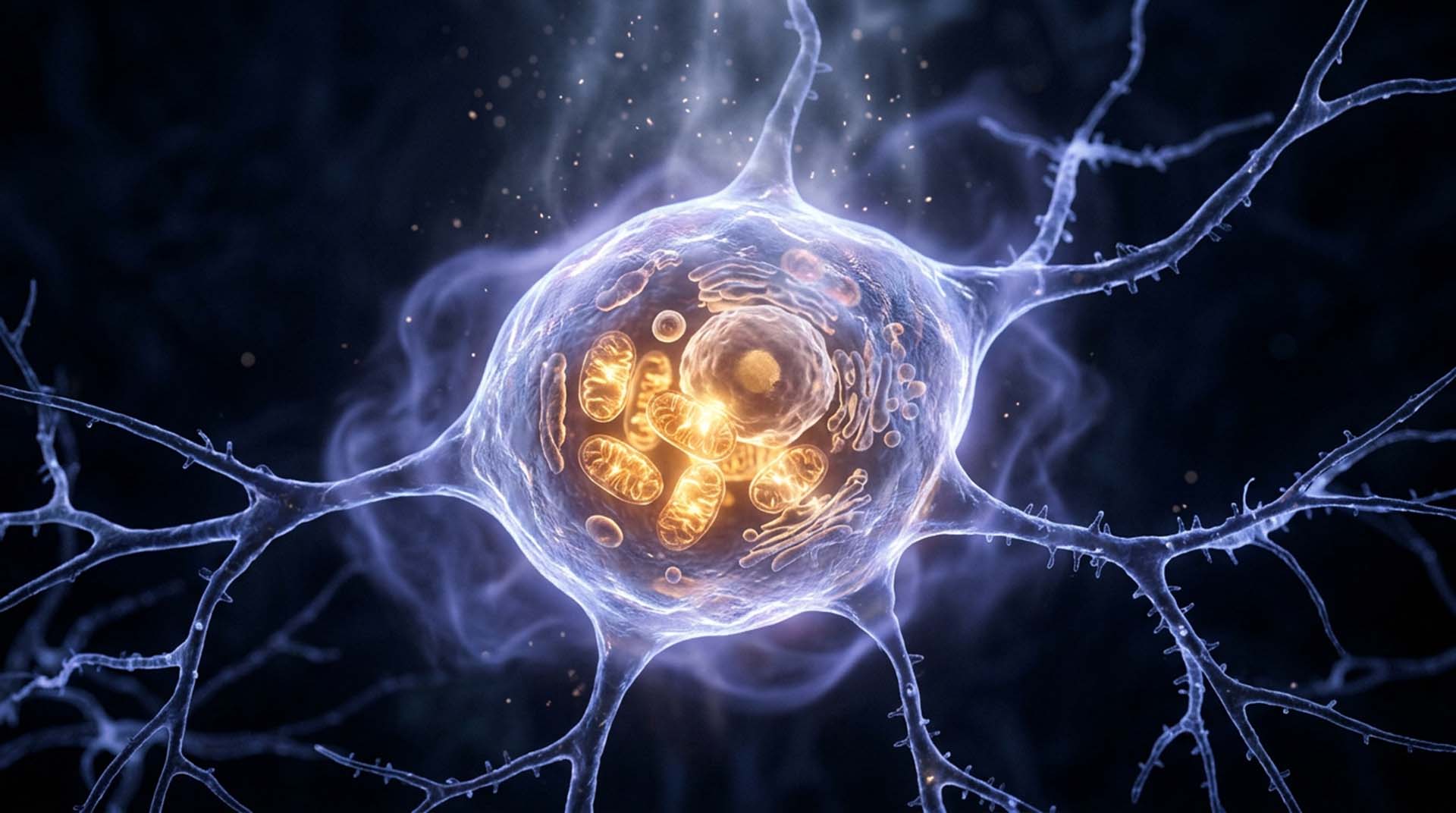
When your cells face a threat (viral infection, bacterial exposure, chemical toxin, physical trauma, chronic psychological stress), they shift their metabolism into a protective mode.
Think of it like a building going into lockdown during an emergency. Doors lock. Alarms sound. Normal operations pause. Everyone focuses on defense.
In this cellular defense mode:
Energy production drops. ATP (the molecule that powers everything in your body) switches from being cellular fuel to being a danger signal. Your cells are saying, “We’re under attack. Conserve resources and warn the neighbors.”
Inflammation rises. Your immune system goes on high alert. Inflammatory molecules flood your system, recruiting immune cells to deal with the threat.
Repair processes pause. Cell growth, tissue repair, detoxification (all the maintenance work your body normally does) gets put on hold. The focus is survival, not thriving.
Cell-to-cell communication changes. Cells stop trusting signals from their neighbors. They hunker down, close their doors, and wait for the all-clear signal.
This response is brilliant when you have the flu. Your cells need to defend against the virus, and this metabolic shift helps them do that. After a few days or weeks, the threat passes, cells get the “all-clear” signal, and they return to normal metabolism.
You recover. Energy returns. Brain fog lifts. Life goes on.
Except when it doesn’t.
Why Your Cells Get Stuck
Here’s the problem that explains your persistent brain fog:
Many people’s cells never fully exit this defensive state.
Even months (sometimes years) after the initial threat has passed, cells remain in what researchers call a “hypometabolic” state. Stuck in survival mode. Still producing 40-60% less energy than normal. Still maintaining elevated inflammation. Still not fully engaging in repair and regeneration.
And when your cells are in survival mode, your brain doesn’t get the energy it needs to function optimally.
Your brain is only 2% of your body weight, but it uses about 20% of your energy. It’s an energy hog, and for good reason. Thinking, memory consolidation, emotional regulation, decision-making (all of this requires massive amounts of cellular energy).
When your mitochondria (the energy factories in your cells) are producing 40-60% less ATP because they’re stuck in Cell Danger Response mode, your brain is the first place you feel it.
That’s your brain fog.
So why do cells stay stuck?
Research suggests several triggers:
Trigger #1: Incomplete Recovery from Illness
Ever notice how some people get a cold and bounce back in a week, while others take three months to feel normal again?
It’s not that the virus is still active in the people who take longer to recover. It’s that their cells never fully completed the transition from defense mode back to normal mode.
This is especially common with:
- COVID-19 (long COVID is essentially chronic Cell Danger Response)
- Epstein-Barr Virus (EBV) or mononucleosis
- Lyme disease
- Any significant infection that wasn’t fully resolved
Trigger #2: Chronic Low-Grade Stressors
Your cells can’t tell the difference between a real physical threat (infection, toxin) and a perceived psychological threat (chronic work stress, relationship conflict, financial anxiety).
Both trigger the Cell Danger Response.
If you’ve been operating in high-stress mode for years (meeting unrealistic deadlines, managing difficult relationships, worrying about money), your cells may have never had a chance to fully exit defense mode.
They’re chronically activated, just like your nervous system.
Trigger #3: Environmental Toxins
Mold exposure, heavy metals (mercury, lead, arsenic), pesticides, industrial chemicals, air pollution… these can keep cells in a defensive state because the threat is ongoing (or perceived as ongoing, even after exposure ends).
Trigger #4: Gut Dysbiosis and Chronic Inflammation
When your gut microbiome is imbalanced and your intestinal lining is compromised (leaky gut), immune cells in your gut stay activated. They’re constantly exposed to bacterial fragments, undigested food particles, and other molecules that shouldn’t be in your bloodstream.
This sends continuous “danger” signals throughout your body, including to your brain.
The result? Cells remain metabolically stuck. And your brain fog persists.
Why Standard Approaches Don’t Fix This
“But I’ve tried everything!”
I hear this constantly. And I believe you. You have tried a lot.
Here’s why those approaches didn’t fully work:
1. More Supplements Don’t Help (If Cells Can’t Use Them)
When cells are in Cell Danger Response mode, they’re not efficiently utilizing nutrients. Their metabolic machinery is focused on defense, not optimal function.
It’s like trying to put premium gas in a car with a clogged fuel line. The fuel is high quality, but it’s not getting where it needs to go.
Taking more B vitamins, more magnesium, more adaptogens, more nootropics… none of that will fix the underlying metabolic dysfunction.
First, you need to shift the metabolic state. Then, nutrients can actually work.
2. Elimination Diets Help… But Not Completely
Removing inflammatory foods (gluten, dairy, sugar, processed foods) is smart. It reduces one category of stressors on your system.
But if your cells are still stuck in Cell Danger Response from a past viral infection, chronic stress, or toxic exposure, diet alone won’t shift them out of defense mode.
You’ll get some improvement (maybe 20-30% better) because you’re reducing inflammatory load. But you won’t get restoration.
3. Sleep Optimization Has Limits
Yes, you need good sleep. Blackout curtains, cool room, consistent schedule, no screens before bed… all important.
But here’s the thing: Deep cellular repair happens during sleep… if your cells are in the right metabolic state.
If they’re stuck in Cell Danger Response, the repair processes don’t fully activate. You can sleep 8-9 hours and still wake up tired with brain fog because cellular restoration isn’t happening the way it should.
Sleep is necessary. But it’s not sufficient when cells are metabolically stuck.
4. Exercise Makes It Worse
This is a telltale sign of Cell Danger Response: post-exertional malaise.
You used to be able to work out and feel energized afterward. Now, even a moderate workout leaves you depleted for days. Your brain fog worsens. Your energy crashes.
This happens because cells stuck in defense mode lack metabolic flexibility (the ability to shift between different energy production pathways depending on what’s needed).
When you exercise, your body needs to ramp up energy production quickly. But cells in CDR mode can’t make that shift efficiently. They’re stuck in one metabolic gear.
So instead of energizing you, exercise depletes you further.
5. Standard Functional Medicine Protocols Plateau
Most functional medicine focuses on:
- Gut healing (remove inflammatory foods, repair intestinal lining, restore microbiome)
- Detoxification (support liver function, bind toxins, enhance elimination pathways)
- Hormone balancing (optimize thyroid, adrenals, sex hormones)
- Nutrient repletion (correct deficiencies through supplementation)
All of this is valuable. But if you don’t address the underlying Cell Danger Response pattern, you hit a ceiling.
You get some improvement. But not restoration.
Because none of these approaches specifically target the metabolic shift needed to help cells exit defense mode.
What Actually Works: Addressing the Cellular Pattern
So if standard approaches miss this, what does work?
You need a protocol that addresses cellular metabolism in three sequential phases:
- Signal cellular safety (help cells recognize the threat is gone)
- Restore mitochondrial function (rebuild energy production capacity)
- Support metabolic flexibility (allow cells to adapt and respond dynamically)
Here’s what that looks like in practice:
PHASE 1: Signal Safety
Goal: Help cells recognize they can exit defense mode
Before you can restore function, you need to reduce the signals telling cells to stay in defense mode.
How:
- Reduce inflammatory triggers: Anti-inflammatory diet (not forever, but initially to reduce cellular stress)
- Support immune modulation: Vitamin D3 (therapeutic dosing, not 1,000 IU – think 4,000-5,000 IU), omega-3 fatty acids (EPA/DHA at anti-inflammatory doses), zinc, selenium
- Restore circadian rhythm: Light exposure in morning, darkness at night, consistent meal timing (all signal “safety” to cells)
- Manage stress: Not just “meditate more,” but targeted vagal nerve support (humming, cold water exposure, specific breathing techniques)
Timeline: 2-4 weeks before moving to Phase 2
PHASE 2: Restore Mitochondrial Function
Goal: Rebuild cellular energy production capacity
Once you’ve signaled safety, you can actively support mitochondrial repair and regeneration.
How:
- NAD+ precursors (NMN or NR) to support cellular energy metabolism
- CoQ10 + PQQ for mitochondrial biogenesis (literally making new, healthy mitochondria)
- Phospholipids (especially phosphatidylcholine and phosphatidylserine) to repair cellular membranes
- Antioxidant support (glutathione precursors like NAC, SOD support, specialized polyphenols) to reduce oxidative stress
Timeline: 4-12 weeks for significant mitochondrial restoration
PHASE 3: Rebuild Metabolic Flexibility
Goal: Train cells to adapt and respond dynamically (not stay stuck)
Once energy production is restored, you work on metabolic flexibility (the ability of cells to shift between different fuel sources and energy states depending on what’s needed).
How:
- Strategic fasting protocols (not extreme 72-hour fasts, but gentle intermittent patterns that train metabolic flexibility without creating stress)
- Movement without overtraining (exercise should help, not deplete – start low and slow, build gradually)
- Adaptogenic support (rhodiola, ashwagandha, holy basil – but in the context of where you are in recovery, not just “take adaptogens”)
- Continued stress resilience building (because life doesn’t stop – you need sustainable practices)
Timeline: 12+ weeks, ongoing optimization
The East-West Advantage
Here’s where it gets interesting, and where my approach differs from most functional medicine practitioners.
Classical Chinese Medicine has been observing these patterns for 3,000 years. They just called them different things.
What Western science calls “Cell Danger Response,” Chinese medicine identified as:
- Qi stagnation (stuck energy/metabolism – literally what we’re describing)
- Damp-heat (inflammation + immune dysregulation)
- Blood stasis (poor circulation, impaired tissue repair)
- Shen disturbance (neurological/emotional dysregulation – what we’d call brain fog and mood issues)
Modern mitochondrial research is finally explaining what ancient physicians observed through centuries of clinical practice.
When we integrate both approaches:
Western approach gives us: Mechanistic precision (NAD+ pathways, mitochondrial function, specific compounds and dosing)
Eastern approach gives us: Pattern recognition (which herbs clear Damp-heat, which formulas move Qi stagnation, how to support the whole interconnected system)
Together, they create synergy neither achieves alone.
Realistic Timeline: What to Expect
If you start addressing the Cell Danger Response pattern comprehensively, here’s what restoration typically looks like:
Week 1-2: Minimal noticeable change (and sometimes initial worsening as cells begin shifting metabolic states – this is normal and temporary)
Week 3-4: First subtle improvements. You might notice slightly better energy mid-afternoon, or one day where your thinking feels clearer than usual.
Week 6-8: Significant improvement. Brain fog starts lifting consistently, you have more good days than bad days, decision-making becomes easier.
Week 10-12: Restoration. You’re back to 90-95% of your baseline function, thinking clearly most of the time, energy stable throughout the day.
This isn’t an overnight fix. Biological restoration takes time.
Your cells didn’t get stuck overnight, and they won’t exit defense mode overnight either.
But when you address the pattern systematically (signaling safety, restoring mitochondrial function, rebuilding metabolic flexibility), restoration becomes possible.
Conclusion
Your brain fog isn’t in your head.
It’s not stress. It’s not aging. It’s not “normal.”
It’s cellular metabolic dysfunction (specifically, the Cell Danger Response), and it’s addressable when you understand what’s actually happening at the cellular level.
Standard approaches miss this pattern. That’s why they give you 20-30% improvement but not restoration.
When you address the root cause (helping cells exit defense mode and restore normal metabolism), clarity returns. Energy stabilizes. You think clearly again.
You get back to 100%.
Medical Disclaimer: The information provided in this post is for educational and informational purposes only and is not intended as medical advice. Always consult with a qualified healthcare professional before making any changes to your health regimen or treatment plan.