
Cell danger response is keeping you stuck.
Six months after COVID, you’re still not right.
The brain fog lingers. Thinking through emails feels like wading through mud. You get winded walking up stairs that used to be effortless. Your energy crashes unpredictably. Some days you’re functional, other days you can barely get off the couch.
You went back to your doctor. They ran labs. Maybe even a chest X-ray or cardiac workup to make sure nothing serious was missed.
Everything came back okay.
“The virus is gone,” they tell you. “Your immune system cleared it months ago. Labs look fine. This is just post-viral syndrome. Give it time.”
But time isn’t fixing it.
If anything, you’re starting to wonder if this is just how life is now. Diminished. Operating at 60-70% of your former capacity. And no one seems to have answers beyond “rest more” and “be patient.”
Here’s what your doctor isn’t telling you (not because they don’t care, but because they don’t know):
Your cells are still stuck in defense mode.
The virus may be gone, but your cellular metabolism never fully completed the transition back to normal function.
This is why you’re still experiencing symptoms months after the acute infection ended.
And understanding why this happens (and what to do about it) changes everything.
Why Some People Don’t Recover
When most people get sick with a virus (COVID, flu, even a cold), here’s what happens:
Week 1: Acute infection. You feel terrible. Fever, body aches, fatigue, brain fog. Your immune system mobilizes massively to fight the virus.
Week 2-3: Recovery phase. Symptoms gradually improve. Energy returns. Within 2-3 weeks, you’re back to 90-95% of baseline function.
That’s the expected trajectory for most people.
But 10-30% of people don’t follow that pattern.
They improve slightly in weeks 2-3, then plateau. Symptoms persist (brain fog, fatigue, post-exertional malaise, difficulty concentrating). Months go by, and they’re still not back to baseline.
This isn’t unique to COVID. It happens with:
- Epstein-Barr Virus (EBV): Some people develop chronic active EBV or infectious mononucleosis that never fully resolves
- Lyme disease: Post-treatment Lyme disease syndrome affects a significant percentage of patients
- Other viral infections: Influenza, viral meningitis, even severe colds can trigger persistent post-viral symptoms in susceptible individuals
So what’s different about these people?
It’s not that the virus is still actively replicating. Tests confirm viral clearance.
It’s not that they have weaker immune systems. Often, these are previously healthy, high-functioning individuals.
The difference is that their cells never exited defense mode.
The Viral-Cellular Connection
When a virus infects your body, it triggers a massive cellular response called the Cell Danger Response (CDR).
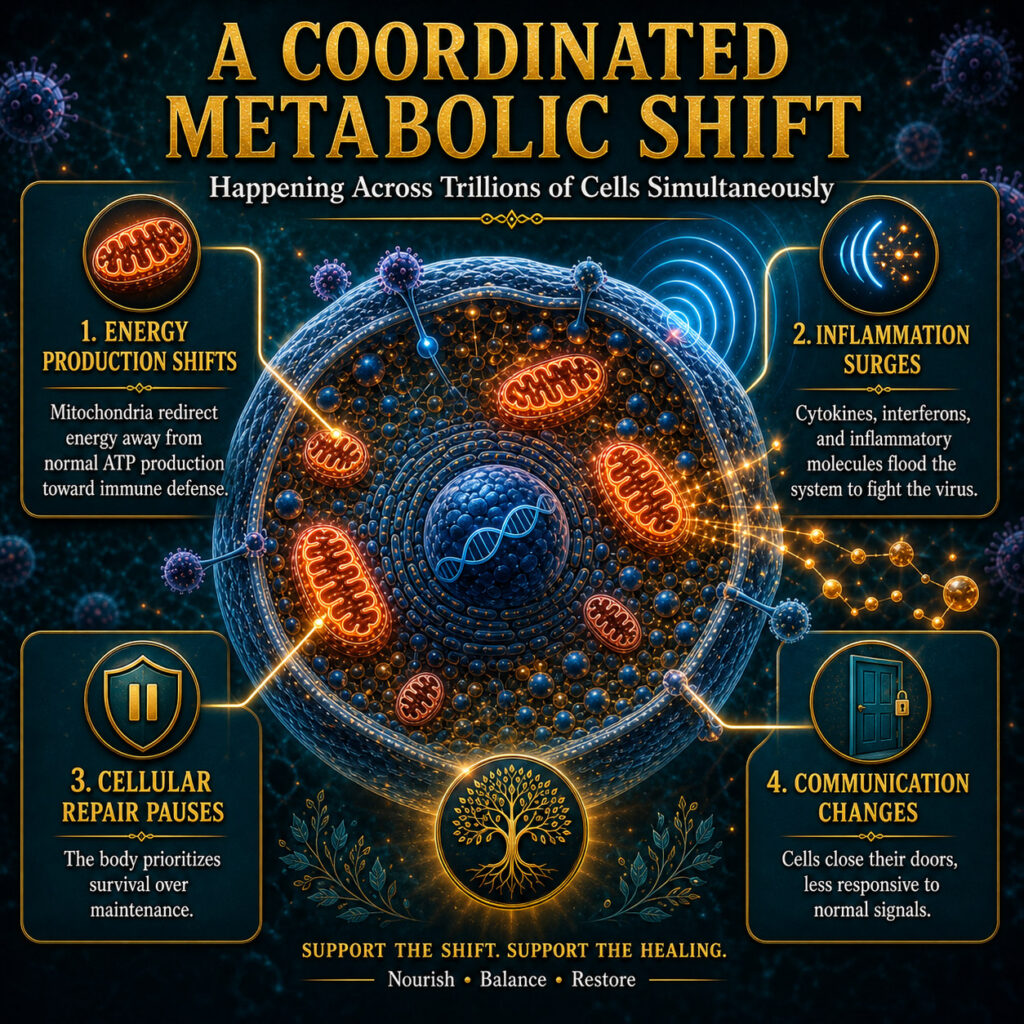
This is a coordinated metabolic shift that happens across trillions of cells simultaneously:
Energy production shifts. Instead of producing ATP for normal cellular function, mitochondria redirect energy toward immune defense.
Inflammation surges. Cytokines, interferons, and other inflammatory molecules flood your system to fight the virus.
Cellular repair pauses. Your body prioritizes survival over maintenance. Tissue repair, detoxification, and regeneration all take a back seat.
Cell-to-cell communication changes. Cells close their doors, become less responsive to normal signals, and focus on internal defense.
This response is appropriate (even necessary) during acute viral infection.
Your body needs to mount this massive defensive effort to clear the virus. Without it, you’d be in serious trouble.
The problem emerges when this defensive metabolic state becomes chronic.
Why Cells Stay Stuck
Here’s the question that explains long COVID and other post-viral syndromes:
Why do some people’s cells remain in Cell Danger Response mode even after the virus is gone?
Research suggests several mechanisms:
1. Ongoing Immune Activation
Even after the virus is cleared, fragments of viral proteins can persist in tissues. Your immune system detects these fragments and continues to respond, keeping cells in an inflammatory, defensive state.
This isn’t “active infection,” but it’s enough to prevent cells from returning to normal metabolism.
2. Mitochondrial Damage
Viruses can directly damage mitochondria (the energy-producing structures in cells). Even after the virus is gone, damaged mitochondria continue to produce:
- Less ATP (energy)
- More reactive oxygen species (oxidative stress)
- Pro-inflammatory signals
This perpetuates the Cell Danger Response even without active viral replication.
3. Chronic Neuroinflammation
The brain is particularly vulnerable. When immune cells in the brain (microglia) become activated during infection, they can remain in an inflammatory state long after the infection resolves.
This explains persistent brain fog, memory issues, and cognitive difficulties in long COVID and other post-viral conditions.
4. Autonomic Nervous System Dysregulation
Viral infections can disrupt the autonomic nervous system (the part of your nervous system that controls automatic functions like heart rate, digestion, and blood pressure).
When autonomic function is impaired, your body stays in a stressed state, which signals to cells that it’s not safe to exit defense mode.
This Explains Long COVID Symptoms
When you understand that long COVID is essentially chronic Cell Danger Response, the symptoms make perfect sense:
Brain fog = Neuroinflammation + energy deficit in brain cells
Your brain uses 20% of your body’s energy despite being only 2% of your body weight. When cellular energy production drops by 40-60% (as it does in CDR), your brain is the first place you feel it.
Crushing fatigue = Mitochondrial dysfunction across all tissues
When your cells are producing significantly less ATP, every activity (even thinking) requires more effort and depletes you faster.
Post-exertional malaise = Metabolic inflexibility
Cells stuck in defense mode can’t efficiently shift between different energy production pathways. When you exercise or exert yourself, your body can’t ramp up energy production quickly enough, so you crash.
Exercise intolerance = Inability to meet increased energy demands
What used to energize you now depletes you for days. This isn’t “deconditioning.” It’s cellular metabolic dysfunction.
Sleep that doesn’t refresh = Impaired cellular repair during rest
Deep cellular restoration happens during sleep, but only if cells are in the right metabolic state. If they’re stuck in defense mode, repair processes don’t fully activate.
Why Standard Treatments Fail
If you’ve been dealing with post-viral symptoms for months, you’ve probably tried various approaches. Here’s why they typically fall short:
Antivirals don’t help because the virus is gone. There’s nothing left to kill.
Anti-inflammatories give temporary relief but don’t address the underlying metabolic state. They reduce inflammation symptoms without shifting cellular metabolism out of defense mode.
Rest helps but doesn’t resolve the issue. Rest is necessary (it prevents further depletion) but it doesn’t actively signal cells to exit Cell Danger Response.
Pacing is necessary but not sufficient. Yes, you need to avoid post-exertional crashes by staying within your energy envelope. But pacing alone doesn’t restore cellular function. It just prevents worsening.
Standard “long COVID clinics” often focus on symptom management (treating POTS, managing fatigue, addressing mood) without addressing the cellular pattern driving all these symptoms.
What Actually Helps: Addressing the Cellular Pattern
If long COVID is chronic Cell Danger Response, then effective treatment must address the underlying cellular metabolism (not just manage symptoms).
Here’s what a comprehensive approach looks like:
1. Signal Cellular Safety
Help cells recognize that the threat has passed and it’s safe to exit defense mode.
How:
- Reduce inflammatory triggers: Anti-inflammatory diet, eliminate processed foods, optimize gut health
- Support vagal nerve function: Specific breathing exercises, cold exposure, humming/chanting, gentle yoga
- Restore circadian rhythm: Morning light exposure, consistent sleep schedule, darkness at night
- Manage stress: Not generic “stress management,” but targeted nervous system regulation
Timeline: 4-6 weeks
2. Restore Mitochondrial Function
Actively support mitochondrial repair and regeneration.
How:
- NAD+ precursors (NMN or nicotinamide riboside) to support cellular energy metabolism
- CoQ10 + PQQ for mitochondrial biogenesis (creating new, healthy mitochondria)
- Phospholipids (phosphatidylcholine, phosphatidylserine) to repair cellular membranes damaged by inflammation
- Antioxidant support (glutathione precursors, SOD support, resveratrol) to reduce oxidative stress
Timeline: 6-12 weeks for significant improvement
3. Support Immune Modulation
Not immune suppression – immune modulation. Help your immune system recognize that active defense is no longer needed.
How:
- Vitamin D3 at therapeutic doses (4,000-5,000 IU daily, individualized based on blood levels)
- Omega-3 fatty acids (EPA/DHA) at anti-inflammatory doses (2-3g combined EPA+DHA daily)
- Specialized pro-resolving mediators (SPMs): compounds that help resolve inflammation
- Low-dose naltrexone (LDN) in some cases (work with a knowledgeable practitioner)
Timeline: Ongoing support, 8-16 weeks for noticeable effects
4. The East-West Integration
Classical Chinese Medicine has extensive clinical experience treating post-viral syndromes. TCM calls this pattern:
- Qi deficiency (depleted energy/weakened function)
- Damp-heat (lingering inflammation and immune activation)
- Kidney Yin deficiency (depleted reserves, poor recovery capacity)
Chinese herbal formulas can support post-viral recovery by:
- Clearing residual “heat” (inflammation)
- Tonifying Qi (restoring energy production)
- Nourishing Yin (supporting tissue repair and regeneration)
Common formulas include:
- Bu Zhong Yi Qi Tang (Tonify the Middle and Augment the Qi Decoction) for severe fatigue
- Gui Pi Tang (Restore the Spleen Decoction) for cognitive symptoms and poor sleep
- Liu Wei Di Huang Wan (Six-Ingredient Rehmannia Pill) for depleted reserves
These work synergistically with mitochondrial support compounds, not as replacements.
Realistic Timeline: What Recovery Looks Like
Post-viral recovery isn’t linear. It’s not “take this supplement for 4 weeks and you’re cured.”
Biological restoration from chronic Cell Danger Response takes 6-12 months.
Here’s what that typically looks like:
Months 1-2: Stabilization
- Symptoms may not improve dramatically yet
- You’re reducing inflammatory load and signaling safety
- Foundation is being built (even if you don’t feel it yet)
Months 3-4: First improvements
- Energy starts stabilizing
- Brain fog begins lifting on good days
- Post-exertional malaise becomes slightly less severe
Months 5-8: Significant progress
- More good days than bad days
- You can do more without crashing
- Cognitive function noticeably better
- Sleep becomes more restorative
Months 9-12: Restoration
- Back to 90-95% of pre-illness baseline
- Able to exercise again (starting gently and building)
- Brain fog largely resolved
- Energy stable and predictable
This requires patience. But many people achieve substantial recovery when they address the cellular pattern comprehensively.
Hope + Action
If you’re months into long COVID or another post-viral syndrome, I know how isolating and frustrating this is.
You don’t look sick. Labs are “normal.” People don’t understand why you’re not better yet.
But here’s what you need to know:
This isn’t permanent.
Your cells can exit defense mode with the right support. Thousands of people have recovered from long COVID and other post-viral syndromes by addressing the underlying cellular metabolic dysfunction.
It won’t be overnight. But it is possible.
You’re not broken. You’re not imagining this. Your cells are stuck in a protective state, and with systematic, comprehensive support, they can shift back to normal function.
Conclusion
Long COVID isn’t a mystery.
It’s chronic Cell Danger Response (a well-understood cellular phenomenon that occurs when cells remain metabolically stuck in defense mode after a viral illness).
The good news? This pattern is addressable when you understand the underlying mechanism and take a comprehensive approach:
- Signal cellular safety
- Restore mitochondrial function
- Support immune modulation
- Integrate East-West approaches
Recovery takes time. But it’s possible.